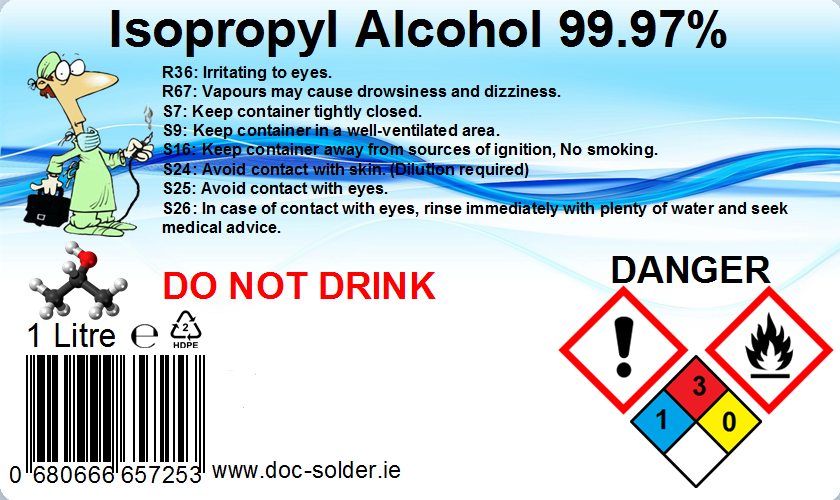
Isopropyl Alcohol 1L
€13.00
26 in stock
Description
Laboratory work and organic extractions.
Electronic cleaning solvent.
Safe easy removal of old thermal compound.
Flux removal.
Cleaning Optics.
Oil based stain removal.
Hot melt glue removal.
Can be used to clean SOME screens, IPA may damage the anti reflection surface on some screens.
Cleaning vinyl records, though this product needs to be mixed with water as it is too pure.
Isopropyl alcohol is also known as:
IPA, Isopropanol, Propan-2-ol, Propanol, Propyl Alcohol
It has the CAS Number 67-63-0
Isopropyl alcohol, an organic polar molecule, is miscible in water, ethanol, and chloroform, demonstrating its ability to dissolve a wide range of substances including ethyl cellulose, polyvinyl butyral, oils, alkaloids, and natural resins. Notably, it is not miscible with salt solutions and can be separated by adding sodium chloride in a process known as salting out. It forms an azeotrope with water, resulting in a boiling point of 80.37°C and is characterized by its slightly bitter taste. Isopropyl alcohol becomes viscous at lower temperatures, freezing at −89.5°C, and has significant ultraviolet-visible absorbance at 205nm. Chemically, it can be oxidized to acetone or undergo various reactions to form compounds such as isopropoxides, e.g. aluminium isopropoxide. As an isopropyl group linked to a hydroxyl group (chemical formula (CH3)2CHOH) it is the simplest example of a secondary alcohol, where the alcohol carbon atom is attached to two other carbon atoms. It is a structural isomer of propan-1-ol and ethyl methyl ether, all of which share the formula C3H8O.
ISOPROPYL ALCOHOL PROPERTIES
Isopropyl alcohol is miscible in water, ethanol, and chloroform, as it is an organic polar molecule. It dissolves ethyl cellulose, polyvinyl butyral, many oils, alkaloids, and natural resins. Unlike ethanol or methanol, isopropyl alcohol is not miscible with salt solutions and can be separated from aqueous solutions by adding a salt such as sodium chloride. The process is colloquially called salting out, and causes concentrated isopropyl alcohol to separate into a distinct layer. Isopropyl alcohol forms an azeotrope with water, which gives a boiling point of 80.37°C (176.67 °F) and a composition of 87.7% by mass (91% by volume) isopropyl alcohol. It has a slightly bitter taste, and is toxic when ingested. Isopropyl alcohol becomes increasingly viscous with decreasing temperature and freezes at −89.5°C (−129.1 °F). Mixtures with water have higher freezing points: 99% at −89.5°C (−129.1 °F), 91% (the azeotrope) at −75.5°C (−103.9 °F), and 70% at −61.7°C (−79.1 °F). Isopropyl alcohol has a maximal absorbance at 205nm in an ultraviolet-visible spectrum.

Reviews
There are no reviews yet.